
Sellers
What to Do When You Get a Low Appraisal Selling Your Seattle Home
July 1, 2026 · 6 min read

By Adriano Tori
Founder & Designated Broker, RexMont Real Estate
WA Lic. #27660
Seattle & Eastside Real Estate Market Strategist
★ BusinessRate Best of 2026 Award Winner
★★★★★ 1,242 Google reviews · Seattle and the Eastside's most-reviewed brokerage
A low appraisal doesn't have to kill your deal. Knowing your options before closing day puts you in control — here's exactly what to do, step by step.
Live market snapshot
Seattle real estate — right now
- Median price
- $940K
- Avg days on market
- 48
- Active listings
- 261
- Months of supply
- 4.1
30-yr fixed today: 7.40%
Source: MLS GRID / NWMLS market data · zip 98103 · 30-yr rate: Freddie Mac PMMS via FRED. Educational only — confirm with a licensed agent.
What Does a Low Appraisal Mean When Selling a Home?
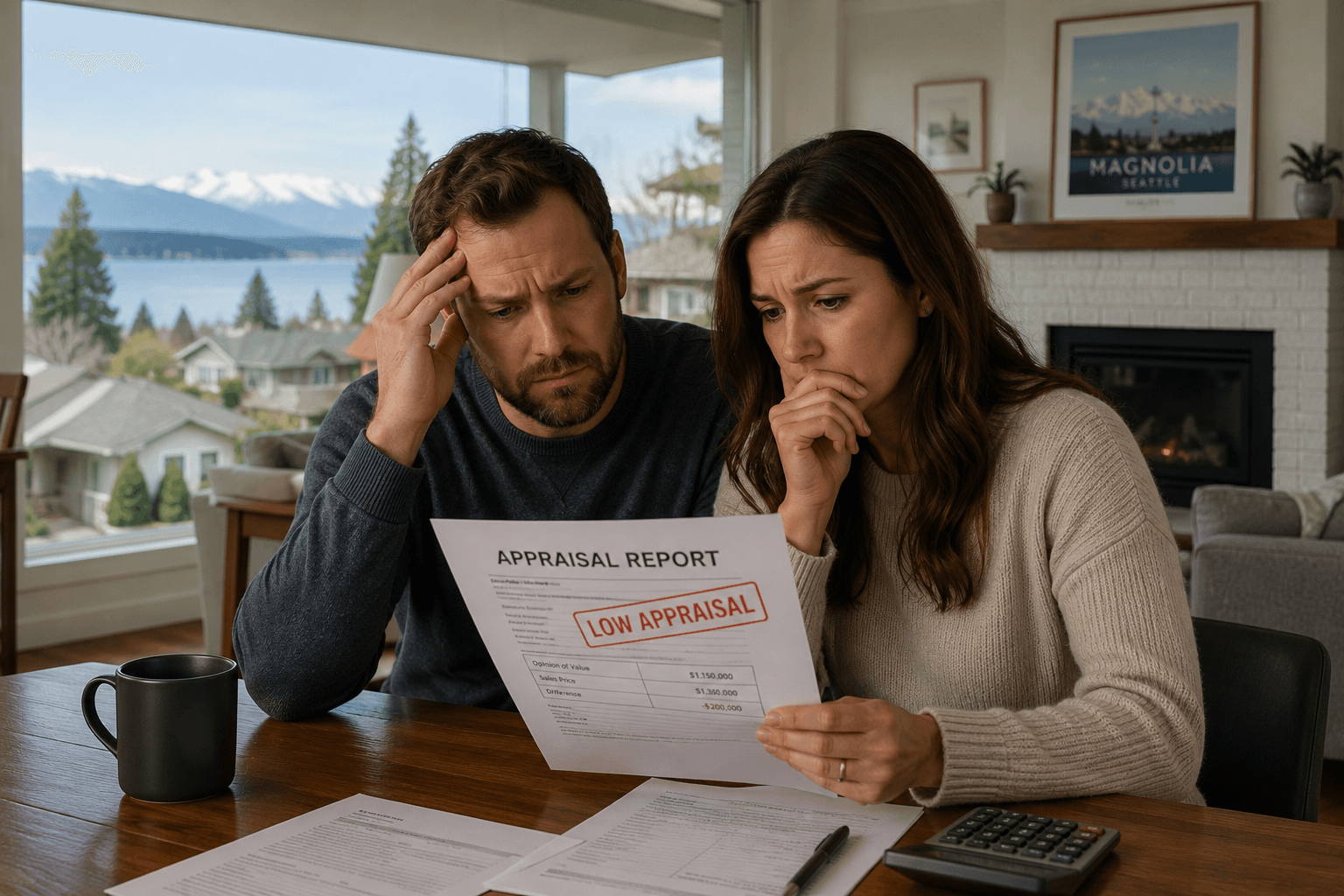
A low appraisal means a licensed appraiser valued your home below the buyer's agreed purchase price. The lender will only finance based on the appraised value, not the contract price. That gap — called the appraisal shortfall — becomes the problem you and the buyer must solve together before the sale can close.
Appraisers compare your home to recent sales of similar properties, called comparables or "comps." In Seattle's denser neighborhoods — Beacon Hill, Columbia City, Wallingford — finding truly comparable sales can be genuinely difficult. Townhomes sit next to craftsman bungalows. Square footage, lot size, and condition vary wildly on the same block. When an appraiser pulls a weak set of comps, the value conclusion suffers.
That gap is not automatically the end of the transaction. It is a negotiation trigger.
Why Do Low Appraisals Happen in Seattle?
Low appraisals happen most often when buyer competition drives an offer price above what recent closed sales can support. Appraisers work backward from data — they cannot use pending sales or current list prices as evidence of value. They use closed transactions, which lag current market conditions by weeks or months.
Seattle's neighborhoods move at different speeds. A surge of offers in Greenwood or Green Lake can push prices faster than closed comps can keep up. When that lag is wide, the appraised value trails the contract price. That is a market timing problem, not necessarily a problem with your home.
Other causes include a low-quality comp selection by the appraiser, a home with unique features that are difficult to bracket, or deferred maintenance items the appraiser flagged as condition adjustments.
What Are Your Options After a Low Appraisal?
When an appraisal comes in low, you have four practical paths. Each one carries different risk and reward depending on how motivated both sides are to close.
1. Negotiate the price down. The buyer's agent will almost certainly request a price reduction to the appraised value. You can agree fully, agree partially, or decline. A partial reduction splits the shortfall — you drop the price by some amount, and the buyer covers the rest in cash.
2. Challenge the appraisal with a reconsideration of value (ROV). An ROV is a formal written request asking the appraiser to review additional comparable sales or correct factual errors. This is not a complaint — it is a documented, evidence-based rebuttal. Your agent should pull every strong comp the appraiser missed and submit them with specifics: closed date, address, adjusted price per square foot. The lender's underwriter submits the ROV on the buyer's behalf; you supply the evidence.
3. Request a second appraisal. If the buyer's lender allows it, a second appraisal ordered by the lender may produce a different result. This is not guaranteed, and lenders control the process — but it is a legitimate option when the first report contains clear errors.
4. Let the buyer cover the gap in cash. Some buyers come to the table with reserves. If the buyer believes in the value, they can pay the difference between the appraised value and the contract price out of pocket. This is called "bridging the gap" and requires the buyer to have available funds beyond their down payment.
5. Cancel the transaction. If neither side can find a workable path, the buyer's financing contingency — if they included one — allows them to exit without penalty. No deal is better than a bad deal, and forcing a sale at the wrong terms creates problems that outlast closing.
How Do You Fight a Low Appraisal With a Reconsideration of Value?
A strong ROV starts with your agent pulling closed sales the appraiser overlooked. Focus on sales that closed within the last ninety days, within roughly a mile of your property, with similar square footage, bedroom count, and condition. In Seattle's denser zip codes — 98103, 98118, 98107 — comp pools can be thin, which makes each overlooked sale significant.
Your agent should document every relevant comp with the MLS number, closed price, price per square foot, and a brief note on how it compares to your home. If the appraiser made factual errors — wrong square footage, missed a bathroom, misidentified the lot size — those corrections go into the ROV as well.
The ROV goes through the lender, not directly to the appraiser. Federal rules under the Appraiser Independence Requirements prohibit sellers and their agents from contacting the appraiser directly. Your agent works through the buyer's agent, who works through the lender's loan officer.
Turnaround on an ROV typically takes several days to a week. Build that into your timeline before your closing date becomes a pressure point.
Can You Negotiate After a Low Appraisal in Washington State?
Yes — Washington State purchase and sale agreements give both parties room to negotiate after an appraisal comes in low. The specific terms depend on what contingencies are written into the contract. Most financed offers include an appraisal contingency and a financing contingency. Review the contract language with your agent or a Washington-licensed real estate attorney before you respond.
The 2024 NAR settlement changed how buyer-agent compensation is handled at the transaction level. Depending on how the buyer's agency agreement is structured, compensation terms may factor into how both sides approach renegotiation. Ask your agent to walk you through the specific terms in your offer.
Washington is not an attorney-required closing state, but the contract language governs every option you have. Know what you signed.
Should You Reduce the Price or Fight the Appraisal?
Fight first, then decide. Start with the ROV before agreeing to any price reduction. If the appraiser missed strong comps or made factual errors, a correction costs you nothing but time. A price reduction costs you real money.
If the ROV fails and a second appraisal is not an option, then negotiate from a position of data. Look at what comps actually support. Look at how far the buyer can stretch their cash reserves. Look at your carrying costs if the deal falls through and you relist.
In Seattle neighborhoods with limited inventory — Phinney Ridge, Magnolia, Montlake — relisting after a deal falls apart can reset buyer perception. Days on market matter to the next buyer's agent. Weigh that cost against the shortfall amount before you walk away from a negotiation.
How to Avoid a Low Appraisal Before You List
Prevention beats remedy. Before you list, pull your own comps. Ask your agent to run a comparative market analysis with the same lens an appraiser uses — closed sales, not active listings. If your pricing strategy relies on sales that are not truly comparable, the appraiser will expose that gap.
Address deferred maintenance items that an appraiser will flag as condition adjustments. A cracked foundation, failing roof, or unpermitted addition creates a direct downward adjustment to appraised value. Fixing visible issues before the appraisal appointment protects your number.
If you are pricing above what comps support, go in with eyes open. That is a legitimate strategy in low-inventory conditions — but structure your listing to attract buyers who can bridge a gap in cash if needed, and price the gap risk into your negotiation plan from day one.
Work With a Broker Who Knows How to Protect Your Number
A low appraisal is a negotiation problem, not a final verdict. At RexMont Real Estate, I work Seattle sellers through appraisal challenges with documented comp strategy, ROV preparation, and clear-headed negotiation — so you close at the best number the market and the contract will support.
Frequently asked questions
- What happens if the appraisal comes in low and the buyer walks away?
- If the buyer's contract includes a valid appraisal or financing contingency, they can exit the transaction without forfeiting their earnest money. You return to the market. Review your specific contract language with your agent to confirm the contingency terms that apply.
- Can I refuse to lower my price after a low appraisal?
- Yes. You can hold your price. The buyer then decides whether to cover the gap in cash, walk away using their contingency, or continue negotiating. Holding your price is a valid position — know your carrying costs and your next steps before you take it.
- How long does a reconsideration of value take in Washington?
- An ROV typically resolves within several business days to about a week, depending on the lender's process and the appraiser's responsiveness. Build that window into your timeline before your scheduled closing date becomes a constraint.
- Does a low appraisal affect the seller's proceeds?
- Directly. If you reduce your price to meet the appraised value, your net proceeds drop by the difference. If you split the shortfall, your proceeds drop by your share. That math should drive your negotiation position — know your bottom line before you respond to any request.
- Is a second appraisal always an option?
- Not always. The buyer's lender controls whether a second appraisal is permitted. Some loan products and lender policies restrict it. The buyer needs to ask their loan officer directly. It is worth requesting — but do not count on it as an automatic right.
Explore related pages
Monthly, by email
The Seattle Journal
One email a month: what sold, what is listed, what it means for Seattle owners and buyers. Written by Adriano Tori, Designated Broker.
Talk to RexMont
Ready to list? Let's build your pricing strategy.
RexMont is Seattle and the Eastside's most-reviewed brokerage — 1,242five-star Google reviews, $1B+ closed. Our agents pair live market data with honest pricing, offer strategy, and negotiation guidance built for Seattle, Bellevue, and the Eastside.
BusinessRate Best of 2026 Award Winner: Real Estate Agent, Bellevue, Washington. Sell with an award-recognized Bellevue real estate agent backed by local client reviews.
Forms and calls go to a live agent — expect a response within minutes during business hours.
Local guide: Seattle real estate agents · Sell my house Seattle WA
Sources & references: Northwest Multiple Listing Service (NWMLS), Federal Reserve Economic Data (FRED), Federal Housing Finance Agency (FHFA), National Association of Realtors (NAR), Washington State Department of Revenue (REET schedules), King County Assessor, Bellevue / Kirkland / Redmond / Seattle municipal permit and zoning portals, Washington State Housing Finance Commission (WSHFC), and RexMont Real Estate in-house transaction data. Statistics, rates, and figures referenced are accurate as of publication and may change. Information is provided for educational purposes and is not legal, tax, financial, or investment advice.
Monthly, by email
The Seattle Journal
One email a month: what sold, what is listed, what it means for Seattle owners and buyers. Written by Adriano Tori, Designated Broker.